

Through Silicon Via (TSV) for Heterogeneous Integration

May 15, 2024

While heterogeneous integration of multiple components and 2.5D/3D packaging techniques pair perfectly with complex stacking architectures, these technologies elicit high demands on device manufacturing processes. Through-silicon via is the key enabler, allowing direct chip-to-chip connection through the chip stack without requiring wire bonding or edge wiring.

The growing demand for miniaturized semiconductor chips and their applications in different sectors such as telecommunications, automotive, aerospace and defense, and consumer electronic devices, etc., is accelerating the growth of TSV technology market globally.  TSV technology allows state-of-the-art packages to increase packaging density and deliver high-performance and low-power consumption.

However, the optimization of TSV process relies on a broad set of technologies. This information series provides insight into ACM Research’s propriety solutions, illustrating its role and importance to TSV processing and explaining the benefits. First, the focus is on cleaning for TSV process using ACM Research’s SAPS™ megasonic technology.

TSV Process Overview

Before delving into TSV cleaning, it’s important to understand what is involved in the TSV process (see Figure 1) including the cleaning challenges it creates. Typically, the TSV goes through the etching process through the silicon substrate to create cavities, and then fill them with a conductive material, such as copper or tungsten, to form a vertical electrical connection.
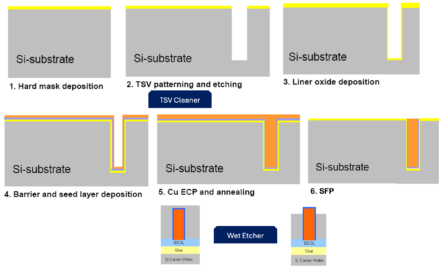
Overview of Through Silicon Via (TSV) process steps

Figure 1. Overview of Through Silicon Via (TSV) process steps

The required TSV size depends on the application. The reactive ion etching (RIE) process, such as Bosch process, is commonly used to fabricate deep vias due to its ability to produce features with vertical sidewalls and high aspect ratio. However, forming these vias with smooth sidewalls is challenged, and the RIE process typically results in the formation of numerous polymer residuals at the bottom and sidewall of vias.

Removing these fluorocarbon polymers and optimizing the TSV requires a reliable cleaning process, after which the via is filled – typically with copper – to make the interconnect between different layers in the 3D stack. This is achieved by electrochemical plating (ECP), followed by the last of these steps, polishing. ACM Research’s proprietary stress-free polishing (SFP) technology affords some unique advantages over other polishing offerings, which will be addressed in part three of this series.

SAPS megasonics

Megasonic cleaning uses sound waves traveling through liquid, producing cavitation – rapid formation and collapse of vapor bubbles within the liquid. Megasonic cleaning’s high-frequency sound waves result in controlled cavitation that gently removes sidewall polymers and residue. By creating a much thinner boundary layer, megasonic cleaning makes chemicals less viscous, enabling them to reach the bottom of vias. This is vital, as incomplete cleaning deteriorates device performance. Particles and residue left in the holes result in low breakdown voltage, high leakage current, and low yield.
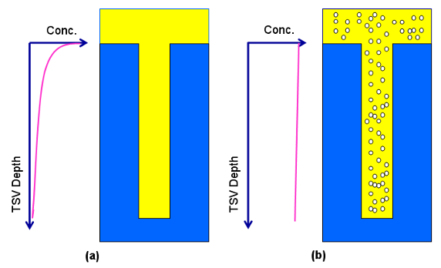
Compared to non-megasonic cleaning (a) chemical concentration in solution reduces with TSV depth at no megasonic effect (b) enhances mass transfer rate and improves the efficiency of residue removal during cleaning.

Figure 2. Compared to non-megasonic cleaning (a) chemical concentration in solution reduces with TSV depth at no megasonic effect (b) enhances mass transfer rate and improves the efficiency of residue removal during cleaning.

ACM Research’s Space Alternated Phase Shift (SAPS™) technology takes megasonics a step further, outperforming conventional megasonic cleaning products and exceeding expectations beyond removing random defects (see Figure 2). Unlike the stationary megasonic transducers used in previous generations of megasonic wafer cleaning systems, SAPS technology moves or tilts the transducer while the wafer rotates, enabling megasonic energy to be delivered uniformly across all points on the wafer, regardless of wafer flatness or uniformity.

On a microscopic level, megasonic energy can reach every point on the wafer surface, removing random defects much more effectively and completely than conventional megasonic or jet spray processes. SAPS technology provides uniform megasonic energy distribution to the wafer surface and demonstrates a clear capability for removing residue at the bottom of vias, as shown in Figure 3.
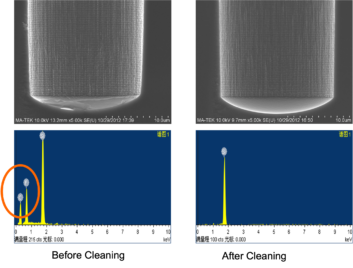
Before cleaning, fluoropolymer residue at the TSV bottom is clearly visible in the SEM image at left, with the x-ray spectra below showing carbon and fluorine signature. Following the SAPS megasonic clean, at right, the SEM shows a clean TSV bottom, with no carbon or fluorine.

Figure 3. Before cleaning, fluoropolymer residue at the TSV bottom is clearly visible in the SEM image at left, with the x-ray spectra below showing carbon and fluorine signature. Following the SAPS megasonic clean, at right, the SEM shows a clean TSV bottom, with no carbon or fluorine.

The results show that SAPS megasonic technology delivers high cleaning efficiency for fluoropolymer sidewall residue removal in post-silicon-etch TSV cleaning processes, yielding minimal damage to the structures and low material loss.

Now that you have formed TSVs and cleaned them efficiently, these need to be plated using a metal appropriate to the device application. ACM Research’s ECP technology helps ensure your final product’s desired quality and electrical performance.

Used in advanced packaging architectures, through-silicon vias (TSVs) are critical to enabling compact, high-performance electronic systems. A TSV is a vertical electrical connection that passes completely through a silicon wafer or die, allowing direct and efficient interconnects between stacked semiconductor devices in 3D integrated circuits (ICs). Common applications include memory stacks, GPUs, data center chips, artificial intelligence (AI) processors, and wireless devices.

TSVs make true 3D integration possible. Unlike traditional wire bonding or redistribution layers, TSVs enable much shorter, denser, and faster interconnects between stacked or side-by-side chips. This improves performance, lowers power consumption, and allows more functions—logic, memory, RF, photonics—to be tightly integrated in a compact footprint. For 2.5D/3D and heterogeneous integration, TSVs serve as the backbone that links diverse dies through silicon interposers or direct stacking, making advanced packaging architectures both practical and scalable.

TSVs create vertical pathways for signals and power that link layers within a chip stack or from a wafer’s front to its back. Their formation involves several sequential steps:

  • Finally, chemical-mechanical planarization (CMP) is used to remove excess fill material. The wafer may also be backside-thinned to expose the TSVs for subsequent steps.
  • Lithography is used to define locations and sizes of the vias on the integrated circuit silicon wafer.
  • High-aspect-ratio holes through the silicon substrate are created using deep reactive ion etching (DRIE).
  • A thin dielectric liner, typically silicon dioxide (SiO2), is deposited on the sidewalls of the via to insulate the conductive material from the silicon and prevent leakage.
  • A metal barrier layer, e.g., tantalum nitride (TaN) or titanium nitride (TiN), is conformally deposited to block metal diffusion into the substrate, and then a copper seed metal layer is added to enable subsequent filling.
  • The via is filled with a conductive material, most commonly copper, using electrochemical deposition (ECD).

ACM Research provides a range of wet-processing and plating systems specifically tailored for TSV and advanced packaging applications:

  • Ultra C SAPS — once the via has been dry etched, the polymers formed during the “Bosch” etch process are difficult to remove. These polymers need to be removed to ensure optimal electrical connections from the silicon, using either a solvent mix or an HF/Sc1 mix with ACM’s SAPS megasonics. This ensures the silicon film is free of residues.
  • Ultra ECP 3d —high-throughput electrochemical copper plating tool designed to fill high-aspect-ratio TSVs with copper, achieving void-less, seam-free fill while optimizing fab space usage and total cost of ownership.
  • Ultra SFP —stress-free polishing solution that addresses yield and structural challenges post-TSV filling by helping to manage copper overburden and reduce wafer warpage—critical issues in TSV and fan-out wafer-level packaging processes.
  • Ultra Pmax PECVD —advanced system designed to eliminate TSV gaps provides uniform insulating coverage at high deposition rates using a wide variety of materials—enhancing overall reliability in heterogeneous integration.

Gap-fill dielectric challenges in TSV fabrication stem from the need to insulate high-aspect-ratio vias without creating voids, seams, or stress defects that can compromise device reliability. Plasma-enhanced chemical vapor deposition (PECVD) is typically employed for this purpose, but PECVD can struggle to achieve deep conformal coverage within the vias, which leads to incomplete fill. Technologies such as advanced high-density plasma CVD (HDP-CVD) techniques, atomic layer deposition (ALD), spin-on glass or flowable oxides can be used to address this issue. These approaches improve step coverage, gap fill, and stress management while minimizing void formation. Hybrid strategies are also used, such as employing an initial ALD or PECVD liner, followed by a gap-fill material and post-deposition annealing or reflow processes. This combination enables reliable electrical TSV isolation while maintaining the mechanical integrity needed for advanced 3D integration.

ACM Research, Inc.
Privacy Overview

This website uses cookies so that we can provide you with the best user experience possible. Cookie information is stored in your browser and performs functions such as recognising you when you return to our website and helping our team to understand which sections of the website you find most interesting and useful.